The Second Chair
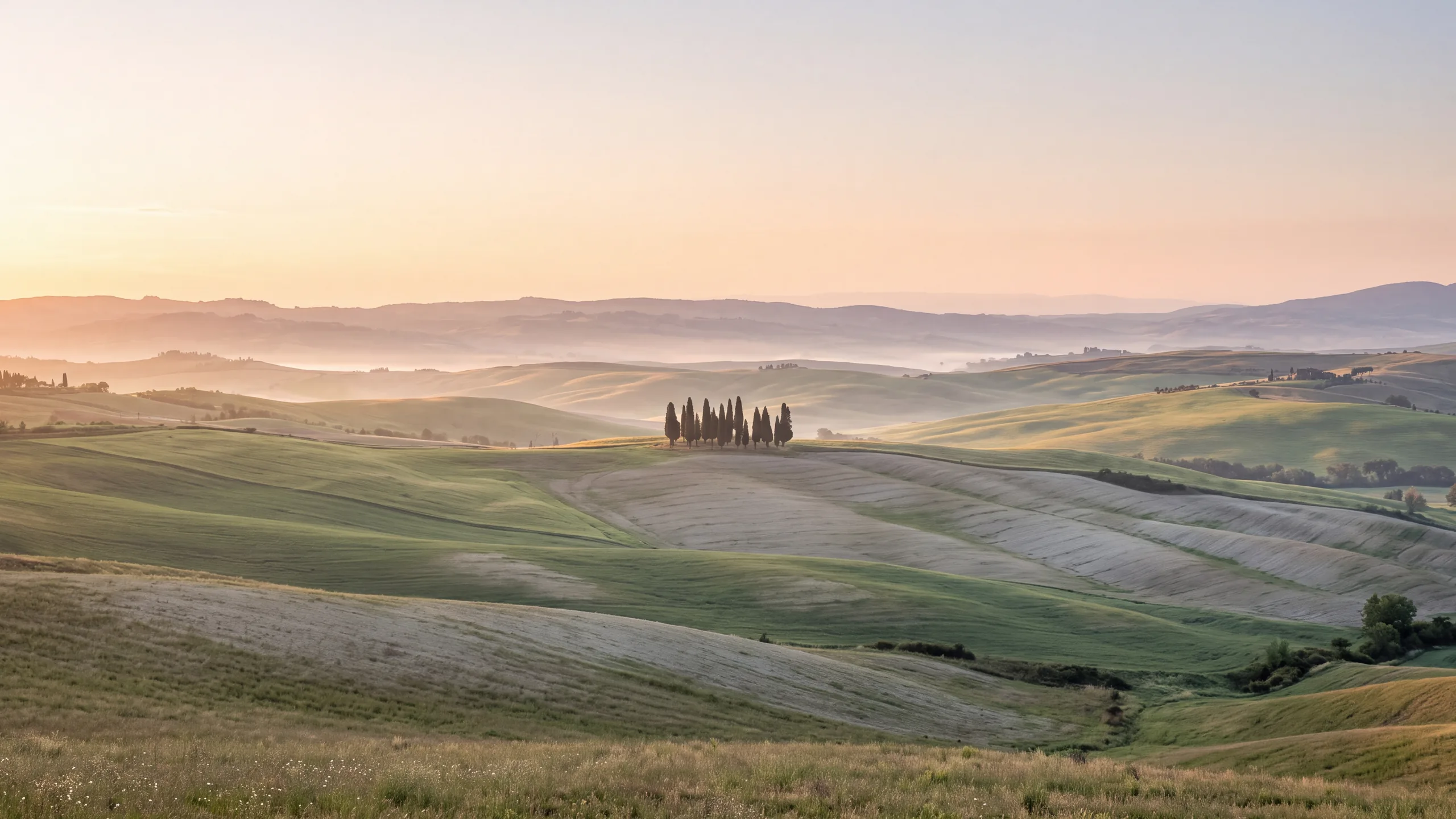
At sunrise, the hills of Val d’Orcia emerged from the mist one field at a time. Bea watched from a footpath outside Pienza as the first light found a row of cypresses, catching their edges while the land beneath them remained pale and indistinct. Somewhere behind her, a kitchen shutter opened. The air smelled of damp earth, and her shoes were already dusty from the lane. She had been awake since five, too pleased with the unfamiliar room and the view beyond it to return to sleep, and had slipped out hoping to have the morning briefly to herself.
A man in a white shirt stood at the next bend, apparently addressing the valley. Bea stopped before he noticed her. His sleeves were rolled unevenly, a sheet of paper moved in his hand, and he had the absorbed expression of somebody trying to remember where he had gone wrong. Then he took a small velvet ring case from his pocket, opened it, and shut it again. Bea turned her attention to the hills. There were private moments a person could stumble into without having any right to remain.
He saw her before she could withdraw and lifted the paper in a gesture of surrender. His name was Julian, and he was staying at the same farmhouse accommodation as she was. They had passed each other at the gate the previous afternoon; she remembered him carrying a suitcase that had lost a wheel and refusing, with theatrical dignity, to drag it. This morning the dignity was less apparent. He had come out to rehearse, he explained, because he could not bear to hear himself say the same sentences once more inside four walls.
Bea knew that a wedding party was gathering at the property later. She assumed she had found its groom and immediately regretted how closely she had noticed his face. Julian was a few years older than her, perhaps forty-four, with a strong nose and a smile that seemed more honest when he was embarrassed. She offered to leave him in peace, but he folded the page and said the cypresses had heard enough. If she was walking toward the next rise, he would be grateful for a conversation in which nobody was expected to be profound.
They kept to the path, the fields falling away on either side. Bea had come to Tuscany for her fortieth birthday, extending a visit with friends in Florence into a week of her own. She was very good at enjoying other people’s suggestions. Choosing what she wanted without a committee had proved more difficult. Yesterday she had spent so long considering where to have lunch that lunch had nearly become dinner. Julian admitted that his first afternoon here had been consumed by an argument with a suitcase, so he could not claim a more enlightened use of time.
The conversation became easy enough to make her initial assumption inconvenient. He wanted to hear about the street in Florence where she had gone back three times because she liked the smell from a bakery. He described the terrible haircut he had given himself at seventeen before his first date, including the second, more terrible haircut intended to repair it. Bea found herself laughing with an abandon that surprised her. Each time she looked over, he seemed to have been waiting to see whether she would.
At the rise they stopped beside a fence, leaving the cultivated field untouched. The mist was thinning, revealing a farmhouse on the opposite slope and the dark punctuation of trees along its approach. Julian took out his paper again but did not unfold it. Bea asked whether the rehearsal was going badly. He said the problem was that everything he wrote sounded as though a much less interesting man were speaking. He could describe almost anything until it mattered, at which point his vocabulary became ceremonial and his family began to suffer.
She suggested that he tell her what he actually wanted to say. He thought about it while the light reached the fence posts. At last he said that his brother had made room for him all his life: at school, at home when things were difficult, at tables where Julian had not felt welcome. He wanted to acknowledge it without making a speech that everyone would endure before being allowed a drink. Bea listened to the plainness of what he had just said and wondered why he had written anything else.
He watched her carefully as she told him that. She could see him considering whether the simple words would be enough, and she liked that he cared so much about getting them right. When he asked whether she would walk back with him, she agreed too quickly and felt the need to establish a sensible boundary.
“Your bride might be wondering where you’ve got to.”
Julian stared at her, then looked down at the ring case in his hand. His laughter was quiet and deeply relieved. “My brother’s getting married. I’m the best man.”
The sun warmed Bea’s face, although it could not reasonably take all the credit for her sudden color. Julian explained that he had been entrusted with the rings the night before and was afraid to leave them anywhere. He had carried them to the sink to brush his teeth. She told him that this seemed an encouraging level of responsibility, and he said she had not seen what he had done with his toothbrush. When their laughter faded, they were still looking at each other. The misunderstanding had occupied more space between them than she had realized.
On the walk back, Julian asked whether anybody would be joining her for the rest of her holiday. Bea said no, then asked the same question of him. He was staying alone for three days after the wedding. They did not pretend these were casual inquiries, and the honesty gave her a pleasant, almost distracting awareness of his hand swinging close to hers. When the path narrowed, he let her go first. She waited where it widened and offered him her hand, as simply as if they had already settled the matter.
The terrace at the farmhouse was beginning to fill. Near the entrance, a silver-haired man with amber eyes and a cobalt-blue scarf moved his chair into the sun and opened a newspaper. Julian and Bea passed him on their way to the quieter end, where the valley remained visible beyond a low wall. Julian secured the ring case in a zipped pocket, then unfolded his speech and crossed out the first several lines. Beneath them he wrote the sentence about his brother making room.
Bea leaned beside him, close enough that their arms touched. He set down the pen and asked if she would be on the terrace that evening, after the wedding party had returned. She told him she would, but that he ought to ask properly. His smile changed. He invited her to share a bottle of wine with him at eight, and she accepted, enjoying the small formality now that it belonged to them.
For a moment she thought he would leave it there. Then he turned toward her and gently touched the hand she had rested on the wall. She looked up, and whatever he had meant to say became unnecessary. Bea moved closer; Julian paused until she nodded, then kissed her. She felt the warmth of his palm against hers and the slight tremor of his breath when she kissed him again. The morning spread across the fields behind him, but she had no desire to look away.
Before he went inside to find his brother, Julian moved a second chair beside the one at the end of the terrace. Bea watched him angle it toward hers instead of toward the view. She touched the back of it as she passed, already certain where she would sit at eight.