The Away Supporters
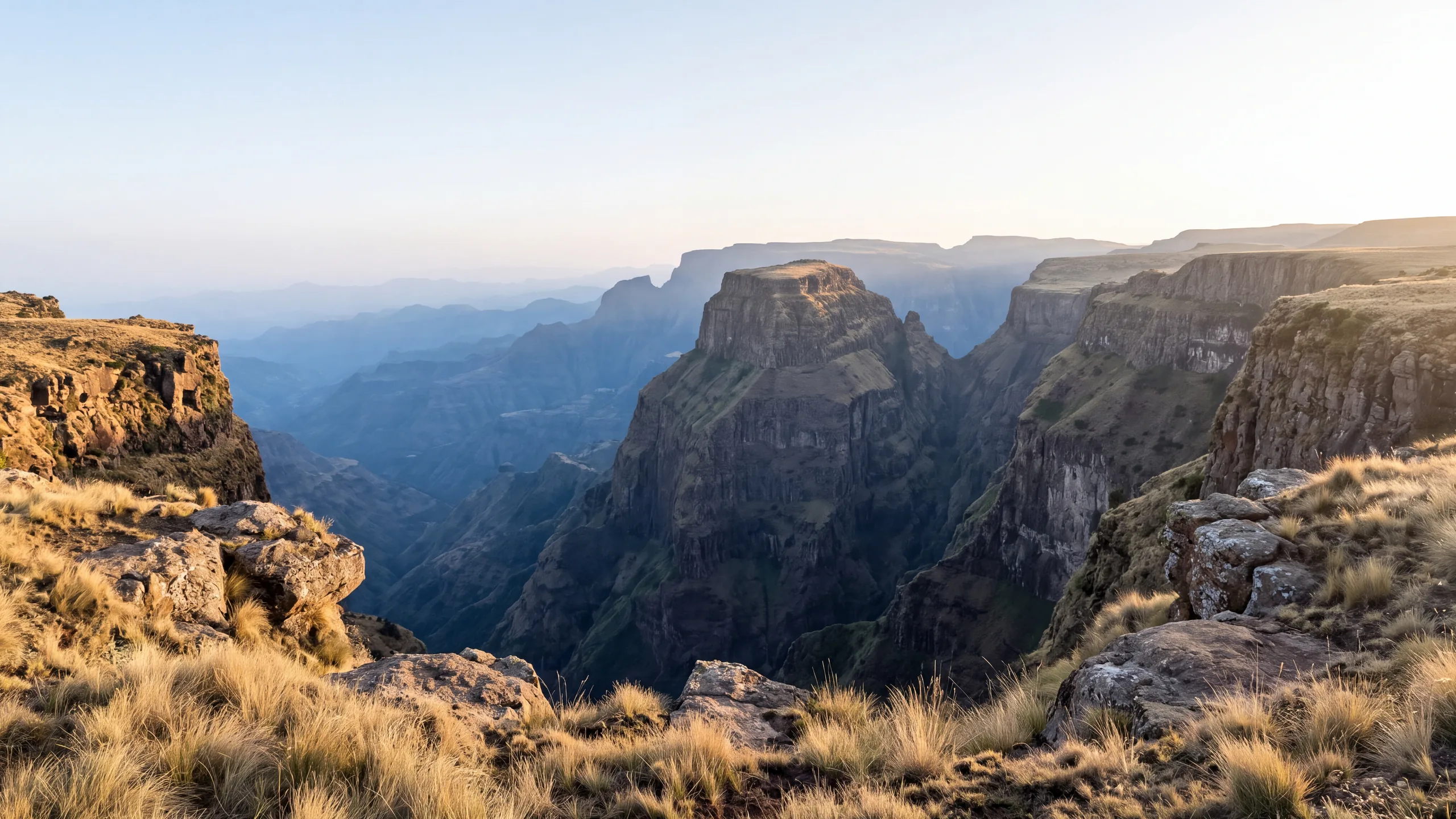
At sunrise in the Simien Mountains, Seble stamped her cold feet against the hard earth. On the other side of the valley, the top of a sheer rock face glowed almost orange. Far below it she could just make out a fold of deep blue shadow where two ridges met. The man sitting on the grass beside her stirred, and from a voice somewhere down near her right knee came the words, “And the crowd rises as one.”
She knew that voice. She had been trying to place it ever since their party set out two days ago. He had introduced himself as Girma, an accountant from Addis Ababa, which had failed to explain why she felt she knew him better with her eyes shut.
He was a cousin of the friend whose sixtieth birthday had brought them all here. Most of the party had known one another so long their talk hardly required whole sentences. Seble had married into the circle and remained after the divorce, uneasily at times. The first evening Girma had found her peeling potatoes on her own. He had sat beside her and asked for a knife. By the time the others came looking for supper they had worked out that they lived three streets apart and bought bread from the same woman, who charged Girma a little extra if he kept her talking past closing.
Since then she had come to look for his sloping shoulders at every halt. He was easy to spot because he carried a pack the startling pink of raspberry ice cream. It belonged to his granddaughter, who had seen him packing for the trip and expressed herself very strongly on the matter of black luggage. Seble liked a man prepared to wear pink at the request of a seven-year-old. She also liked the breadth of the shoulders under it, and the shy pleasure in his eyes when he caught her looking.
Now he made room for her on his folded coat. Behind them a silver-haired man with amber eyes and a cobalt-blue scarf picked grass seeds from the wool of his socks. The rest of the group had gone a little farther up the trail with their guide. Seble was content to stay where she was. From here she could follow the cliffs back for miles, each ridge a little paler until all she could make out was the faintest pencil line of peaks against the sky.
Girma offered her a cup of coffee from his flask. When he bent his head his voice took on the slight muffled rasp she remembered, and all at once she could place herself in the room where she had heard it. She had been handing out clean shirts to eleven-year-old girls in a school changing room. On the other side of the wall somebody was testing a borrowed microphone. One two, one two. And the crowd rises as one.
“You did the commentary at the girls' matches,” she said. “You called my daughter the Minister of Defence.”
Girma spilled some coffee on his knee. He remembered the Minister very well. She had been a tiny girl who stood her ground against players twice her size, then sat down in the middle of the pitch to retie her boot the instant the ball went out. For three seasons he had perched on the equipment shed with a microphone and a borrowed speaker so that eleven girls could hear what it might be like to play in a stadium. Seble's daughter was thirty now and still signed her birthday cards to her mother with her old title.
Seble could see that this pleased him far more than he was able to say. She thought of the woman she had been then, collecting shirts at the end of every match, taking the bus home with the wet load on her lap. How she had loved the afternoons when that voice came floating in through the dressing-room window. She had imagined someone young and rather full of himself. It had taken two mornings in the mountains and a good many potatoes for her to discover how rarely Girma said a word about himself at all.
She asked about his daughter. The girl who had played on the opposite side now had a girl of her own, the same one who had lent him the backpack. On Sundays the two of them went to watch her mother play. He admitted that watching a match was about the only thing his granddaughter disliked doing in his company. Even with his mouth shut, he had been informed, he was clearly thinking the commentary.
Seble laughed until she had to lean on him, and found that he was willing to be leaned on. When she straightened he left his arm lying along the coat behind her. She asked which side his daughter played for. When he described the green shirts with the yellow cuffs, she knew exactly who would be playing them on Sunday. Her own daughter had put the fixture on her mother's calendar in the hope of enticing her to an away match. It occurred to Seble, with a pleasurable little jolt, that she could invite a man to sit beside her the way she might have done at twenty. Girma could have Sunday afternoon, she told him, if he could stand to spend it among the away supporters.
“If I'm sitting with you, they'll have to have me,” he said.
It was the quietness with which he said it that moved her. She covered his hand with hers. For a little while they had the whole view to themselves, the sun warming the dry grass under the backs of their legs and the air still sharp enough to make her eyes water. She rested her cheek against his shoulder. His lips touched her hair, very lightly, and she tipped her face toward him so he could kiss her properly.
They were still there when the birthday party came down the trail. Somebody called to ask what they had found to look at for so long. Seble thought he might make a joke of it. Instead Girma held the pink pack out to her, she put the flask back in its pocket, and they got to their feet the happy, ordinary way they would rise from two seats in the sun the following Sunday, his hand going out for hers.