The Unfinished Game
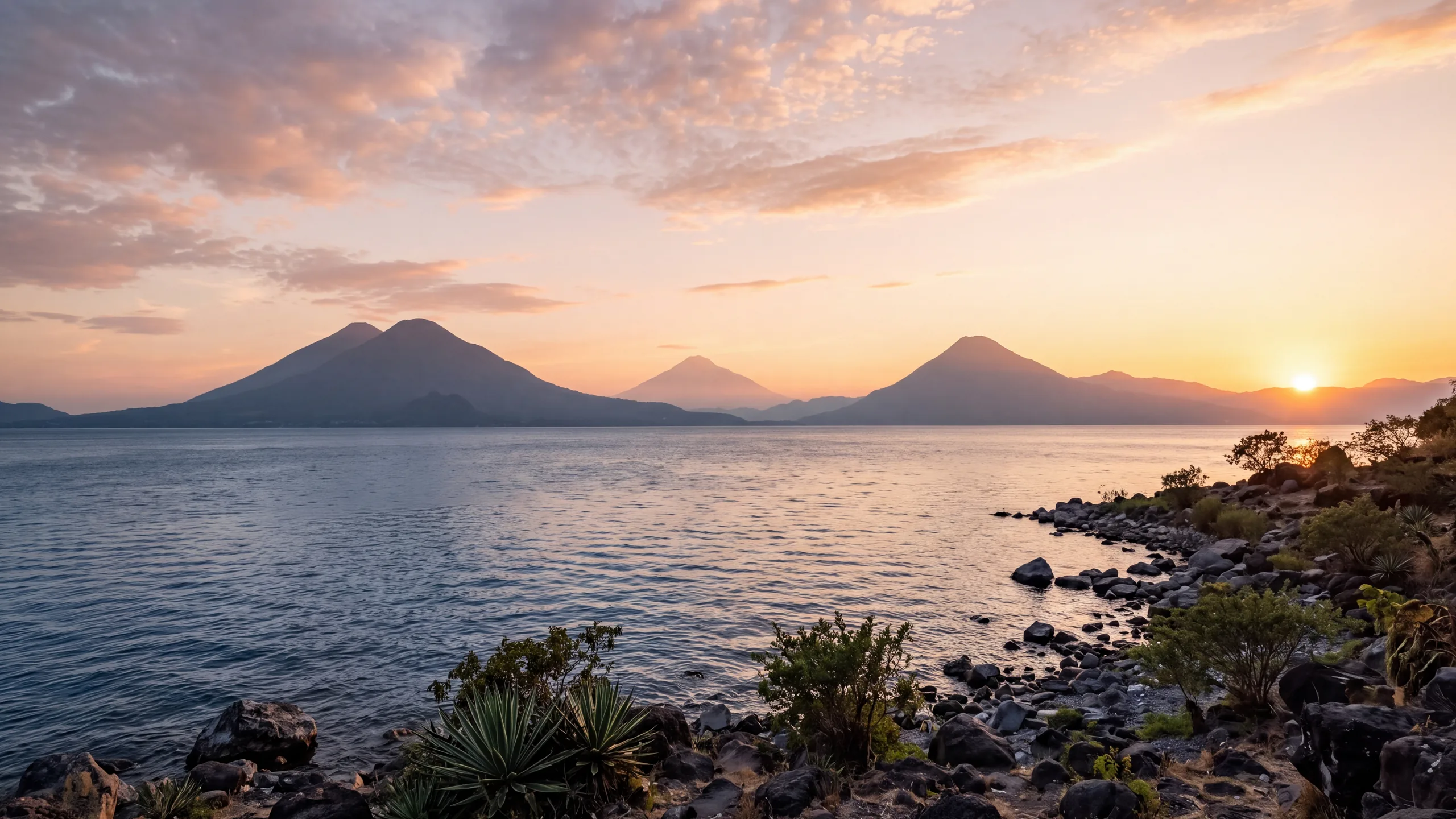
At sunset, Lake Atitlán turned the color of the blue glass Ana's daughter used to collect, every ripple holding a little light. Across the water, the volcanoes rose in overlapping silhouettes, their lower slopes already lost in haze. Coral clouds brightened above them. From the terrace on the northeastern shore came the smell of warm tortillas and the scrape of a chair, and Ana found herself reaching for her phone before remembering that she had promised to send only one photograph that evening. Lucía was nineteen, traveling with friends, and entitled to a few hours without her mother admiring things at her.
Ana put the phone away. At forty-three, she was learning that a holiday could belong entirely to her. She had booked four nights beside the lake while Lucía finished her own journey through Guatemala, and they would meet afterward. Their separation had sounded wonderfully sensible at home. Here, with an empty chair beside her and the water becoming more beautiful by the minute, Ana had briefly regretted being sensible.
The man at the next table was studying a chessboard. He had been there the previous evening, in the same open-necked shirt, considering what appeared to be exactly the same position. A sheet of paper lay beneath his glass. Every so often he reached toward the board, stopped, and wrote something down. Ana knew enough chess to recognize the opportunity he kept refusing, although not enough to be certain there wasn't a trap.
When he looked up, she was still looking at his hand.
“Your bishop,” she said. “Unless I'm missing something.”
He glanced down with such gratitude that she laughed. He invited her to show him, admitting that he was almost certainly missing several things. Ana brought her drink over. From nearby, a sultry woman with sea-green eyes and a wine-red scarf rose to follow her companion inside, leaving the terrace quieter. The man introduced himself as Mateo and made room for Ana's glass with the solemn care of someone handling a more delicate arrival than a woman and a lemonade.
He was forty-six, a laboratory technician from Guatemala City, spending a week's leave at the lake. His older sister lived abroad; once a year they met somewhere with their families, but this time she couldn't come until the weekend. He had decided to arrive early. Ana liked that he offered this without apology, as though wanting time in a beautiful place needed no better explanation. She told him about Lucía and discovered that she could speak of her daughter without immediately reaching for pictures.
They tried the bishop's move. Mateo studied the consequences, then restored the pieces to their original squares. Ana asked whether he was recreating a famous match. The seriousness returned to his face, although there was something unreliable about it now. He said that it was an important game and that he would like, just once, to finish it properly. He had until Saturday to work it out.
She bent over the board. His notes contained little arrows and several question marks, but none of the tidy notation she expected from a serious player. Beside one diagram he had written, in capitals, DON'T FORGET THE HORSE. When she noticed, he covered the words with his palm too late. His embarrassment was so open that she resisted the easy joke. Instead, she asked if he would like to play a fresh game with her.
He hesitated, looking toward the lake as if the evening might provide an excuse, then began arranging the pieces. They played without a clock. Ana had learned years ago from an elderly neighbor who cared very little whether she improved, provided she stayed for a second cup of coffee. She remembered the pleasure of those afternoons more clearly than the rules. Mateo remembered the rules better but had difficulty believing that she would really take an unguarded piece from him.
She did, and his delighted protest made two people at the next table turn around.
As the game went on, their conversation wandered away from it. He told her about the first terrible cake he'd made in his new apartment and the second, which had been only slightly less terrible. She described the women's football team she'd joined, at Lucía's urging, and the dignity of being repeatedly outpaced by a grandmother of six. They were both accustomed to being useful. It was a relief, Ana thought, to discover how much she liked hearing about his harmless failures.
When the breeze lifted the paper, they reached to save it together. His fingers closed over hers for a moment. He released them, but the brief warmth stayed with her. After that she noticed every time he leaned across the table, the faint crease beside his mouth when he concentrated, the low way he said her name when he wanted her attention. She had not felt this deliciously distracted in years. At one point she forgot whose turn it was, and Mateo confessed that he had been hoping she wouldn't ask.
His phone lit beside the board. On the screen was a photograph of a small girl with two missing front teeth, holding a paper crown above her head. Mateo turned it so Ana could see the message beneath it. His niece, Elisa, wanted to know whether he was practicing. She intended to beat him fairly this year.
The important game became clear. Last summer he had tried to let Elisa win, and she had noticed. Worse, she had explained to the assembled family that he was so bad at pretending to lose that it made winning unpleasant. This year she had joined a school chess club. He had promised her a proper opponent and come to the lake with a borrowed board and the position in which he had last surrendered.
“I thought learning might be less humiliating here,” he said.
Ana looked past him at the volcanoes, now deep blue beneath the bright clouds. She liked the trouble he had taken, and the small girl's right to an honest victory. She liked him still more for admitting how little he knew. Drawing the paper toward her, she traced one of his arrows and showed him where the knight could go. She would happily help him practice, provided he didn't start letting her win too.
They finished their game as the terrace lamps came on. Mateo lost after a stubborn defense, and Ana found she was pleased he hadn't made it easy. He photographed the final board, sent it to Elisa with an honest report, and received a row of triumphant faces. Then he closed the chess set. For the first time all evening there was nothing between his hands and hers.
He asked whether she would walk with him along the terrace. At the far end, above the dark rocks of the shore, they stopped where the last color lay across the water. Ana rested her hand on the railing. Mateo laid his beside it, close enough for her to choose the distance, and she threaded her fingers through his.
“I'd like another evening with you,” he said. “Even if you beat me again.”
She turned toward him, smiling. Another evening sounded wonderful; waiting for it sounded less wonderful. She touched his cheek and asked if she could kiss him. His answer came before she had quite finished the question. The first kiss was warm and careful. She drew closer for the second, feeling his hand settle at her back, and for a little while she forgot the cooling drink, the board, even the immense dark water below them.
When they returned to the table, Ana moved her bag from the chair beside hers to the floor. Mateo sat down there. She sent Lucía her promised photograph of the lake, then put the phone away before a reply could arrive. Tomorrow she would explain that she had found someone who needed lessons. Tonight, with Mateo's knee touching hers beneath the table, she let him set up the pieces for another game.