When the Camera Stopped
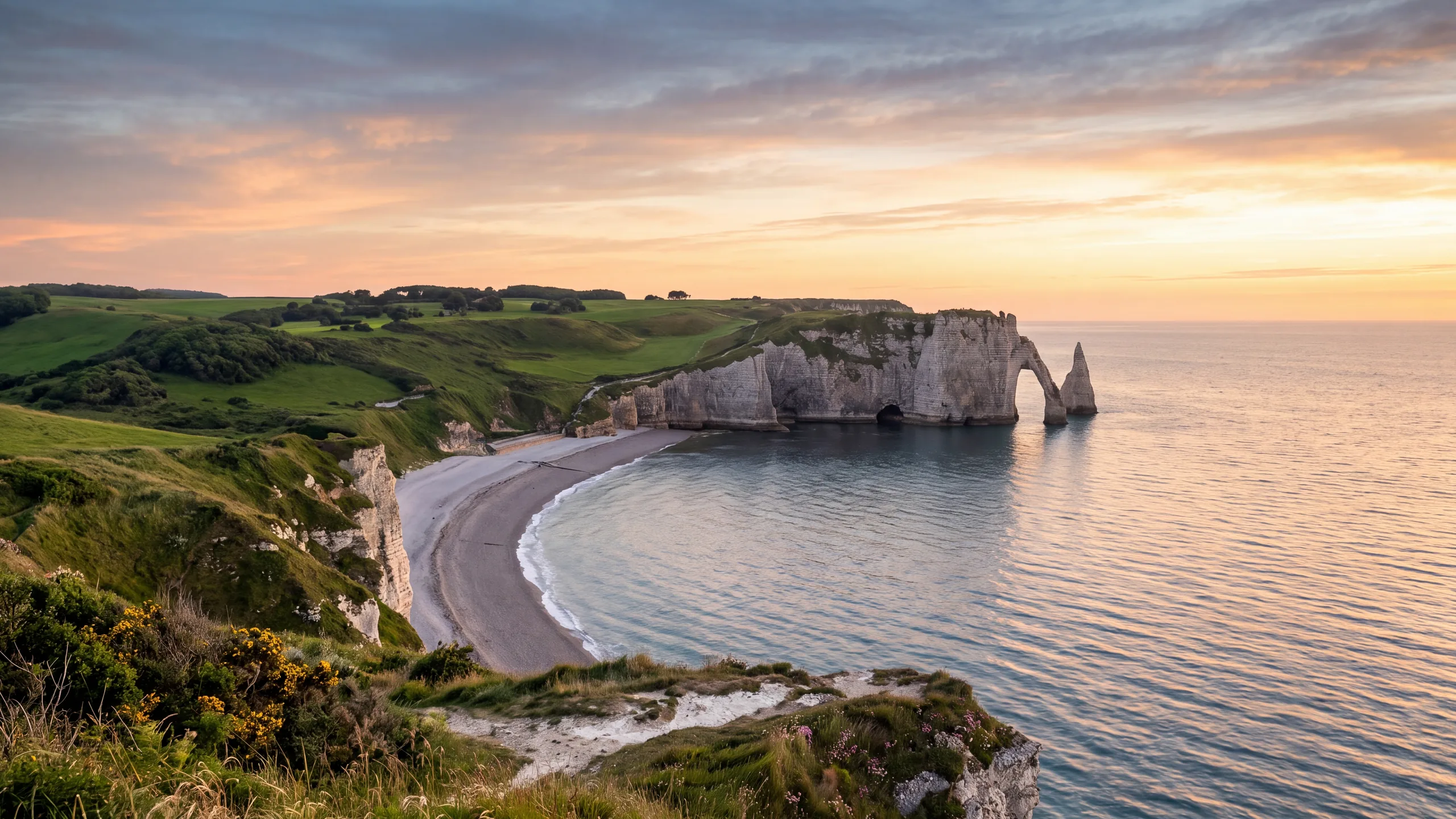
By sunset at Étretat, Alice had let her hat blow off four times and was beginning to hope she might get to do it again. Out beyond the pebble beach, the last light shone clear through the chalk arch and picked out the edge of the tall needle of rock beside it. Closer in, the water had turned the color of apricots in syrup. As soon as somebody called for quiet, she would walk along the promenade, lose her hat to a length of fishing line, and fall into step beside the man who caught it.
It was a modest part. Her neighbor Léon, who was making his first short film at the age of seventy-three, had assured her the entire performance would occupy ten seconds, and nobody had ever died of embarrassment in ten seconds. This reasoning had also persuaded Martin, the man in the borrowed overcoat, whose ordinary occupation was selling kitchen appliances. His shop was two doors down from the office where Alice did people's accounts. She had passed it twice daily for years. Until Léon started filming, the longest conversation she had ever had with Martin had concerned the rubber seal on her refrigerator.
She wished she had known how he was going to look in that ridiculous overcoat. The shoulders sat too high and the cuffs obscured half his hands, but once he had caught her hat, he took it off the line and gave it to her with such grave courtesy that the first time she had actually thanked him. The second time he said, under cover of the waves rattling the pebbles, “Lovely weather for refrigerators.” She had ruined that take by laughing.
The trouble with the next two was harder to understand. As soon as they had walked a short distance together, Léon was supposed to call cut. Instead the camera kept running. The first time they had separated and looked back in confusion. The second they had reached the end of the promenade and started to walk around a litter bin before Léon lowered his camera. Now the wind was getting under the brim in earnest. Alice put her hand on top of the hat while a sultry woman with sea-green eyes and a wine-red scarf passed close beside her, carrying two paper cones of chips.
Martin followed the cones with his eyes. He had been on his feet since seven that morning, he told her. A woman trying to choose a new oven had brought a full-size goose made out of newspaper to see whether it would fit. He had kept the goose when the customer went home. Alice, who at forty-four felt she had spent a great deal of time smiling politely at men with surprisingly little to say, found herself wanting a detailed description of this goose. He got as far as the twisted neck and the little hat it wore before Léon gathered them for the last of the light.
This time the hat came free just as the sun touched the water. Martin caught it. Instead of returning it straightaway, he held it a little above her head. She lifted her face. His smile softened as he looked down at her. When he settled the hat on her hair, he did it so gently that she could feel the separate touches of his fingers through the felt.
They began to walk. Alice was conscious of the fabric of his sleeve brushing her hand and of the hollow knock of her heels on the promenade. She wanted the walk to last, in spite of the litter bin that lay ahead of them. As they approached it Martin offered her his arm. She slipped her hand through it, and they turned together to look back at the sea. Behind them came Léon's voice at last, declaring himself satisfied.
He showed them what he had been waiting for on the little screen. They watched themselves grow smaller in the frame. With their backs to the lens and their awkward faces out of sight, there was suddenly something more interesting to watch than a woman and her hat. It happened in the moment before the turn, when Martin's elbow moved a little away from his side and Alice's hand was already there to meet it. They looked like two people who had been walking together for years.
Léon went off to retrieve his fishing line. Martin put his hands in the deep pockets of his overcoat. The wind took a lock of hair across his forehead, and Alice had to fold her arms to keep from reaching up to put it straight. Now they had finished filming, she had lost her excuse to touch him. She was grateful when he broke the silence.
“I'd rather like to find out what happens to those two,” he said.
It would have been easy to continue the joke. She could have sent the pair of them off to buy a refrigerator or furnished them with a house full of paper geese. But when she looked at him she found that she wanted to speak for herself. She told him she would like to see the goose in his window. She would like to eat something hot first, and she would like to give him a kiss, if he thought that might be a good place to begin.
He took his hands out of the long overcoat sleeves. One settled at her waist, warm through her dress, and with the other he tipped the brim on her head a little higher. She reached up to take hold of his lapel. The first kiss was full of all the things that had kept interrupting them, the wind and the salt and the laughter she had swallowed when she was supposed to be acting. For the second they took their time.
As they started back the arch was losing its last fine rim of light. Alice shivered and Martin put the overcoat around her shoulders. She reached up and set the hat on his head in exchange, and he bent to look at his reflection in a dark window before offering her his arm again. There was a shop window she wanted to look at on the way home, and he knew where they could get chips.