The Mountain in His Pocket
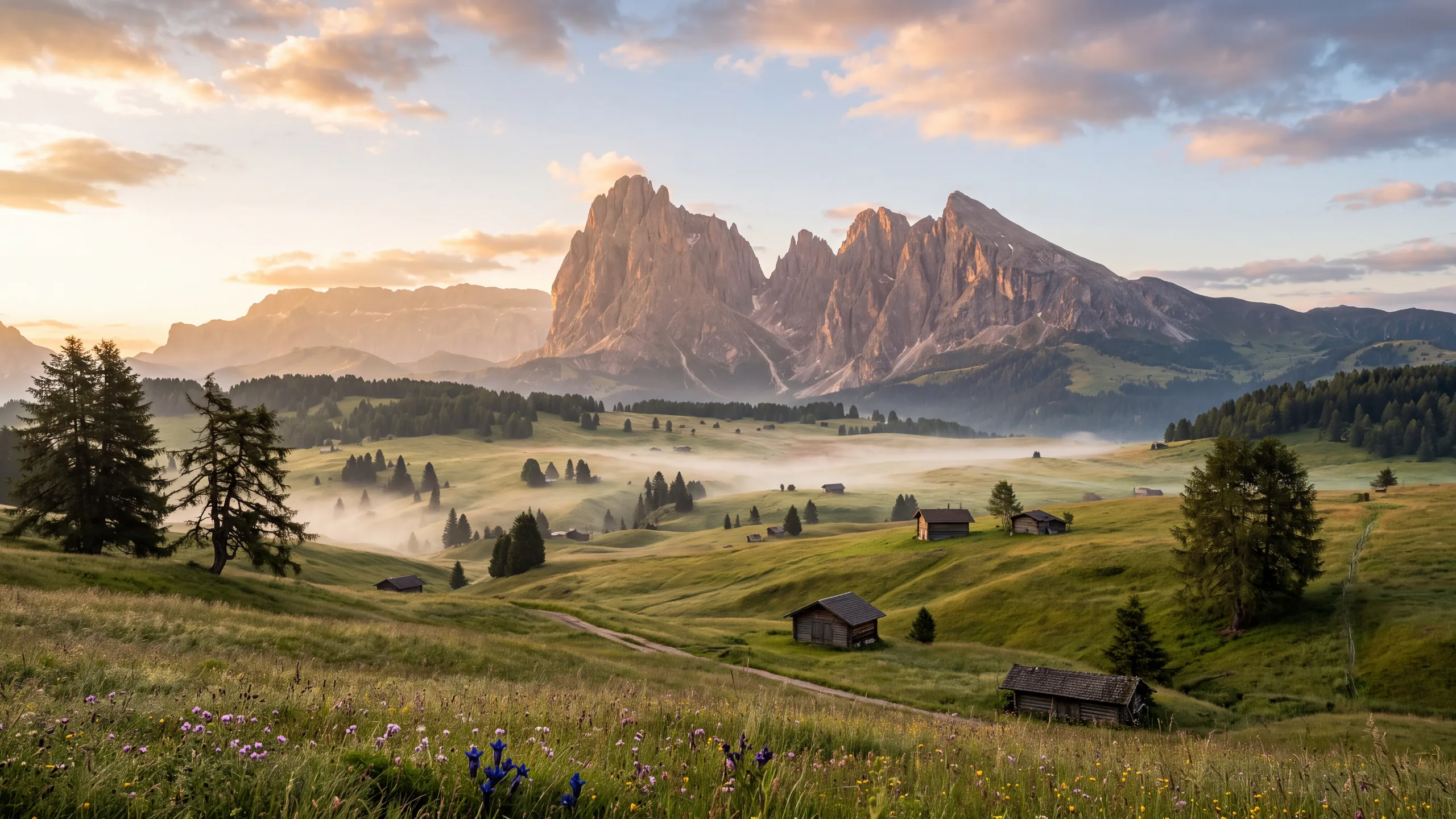
Sunrise was moving down the Dolomites when Iris noticed the man holding a small gray stone against the sky. Above Alpe di Siusi, the peaks had caught the first gold, while the meadow beside the walking path still shone with dew. Mist occupied the hollows between wooden huts. Somewhere beyond it, cattle were beginning their day, and the air smelled of wet grass and the bread the innkeeper had wrapped for her before she left. She had come out to enjoy the morning of her fortieth birthday. The stone was an unexpected distraction.
The man turned it between his fingers, compared it with the mountains, then put it away with an expression of dissatisfaction. Iris recognized him from the inn, where he had spent the previous evening losing a card game to two elderly women. He had accepted defeat with enough good humor that she had wished she were sitting at their table. Now he was alone beside the path, his dark hair flattened on one side by a hat he had removed too soon.
She asked whether he had found a match. He glanced at her, surprised, and then smiled as though she had caught him at something mildly embarrassing. The stone, he explained, had come from his mother's garden in England. She claimed it looked exactly like a mountain she had seen here on her honeymoon. He had brought it along to settle the question. His father maintained that it resembled a potato.
“I was hoping to send them proof,” he said. “So far, the potato is winning.”
Iris laughed, and the morning became less solemn. She had been treating forty as though it required an appropriate response: a difficult walk, an important thought, perhaps a photograph in which she looked unusually certain of herself. She was a school librarian, accustomed to encouraging children who believed that every blank page had to begin brilliantly. Apparently she had learned very little from her own advice.
His name was Martin. He was forty-three, worked in railway operations, and had taken a week between shifts to walk somewhere his phone could remain in his bag. He offered her the stone. It was no larger than a plum, smooth on one side and sharply ridged on the other, with a pale seam across its middle. She kept her glove off after returning it, although the air was cold. His fingers had touched hers, and the small warmth stayed surprisingly distinct.
They followed the marked path together, with the pale bulk of the Sciliar rising beyond the meadows. Martin did not pretend to know which mountain his mother meant. He had asked her to send a photograph, but she preferred to let him investigate. Iris liked the affectionate exasperation in his voice. He spoke about his parents as people who still surprised him, capable of nonsense and disagreement after years together. It made her curious about what he would notice in someone he loved.
At a narrow place, they stepped aside for a silver-haired man with amber eyes and a cobalt-blue scarf, who passed with a quiet greeting and a folded map in his hand. Martin moved close enough that Iris felt his sleeve against hers. Neither of them immediately reclaimed the width of the path. They continued almost shoulder to shoulder, their boots making a steady, companionable sound on the gravel.
The sun reached the nearest rise. Individual stalks of grass suddenly gleamed, and the huts acquired clean brown edges as the mist thinned around them. Iris stopped to take a photograph, but Martin distracted her by crouching and holding the stone at a new angle. The serious concentration on his face was so pleasing that she took his picture instead. She showed him before saving it. He approved, with the condition that she send it to him herself rather than let his mother obtain evidence of how thoroughly he had embraced the assignment.
Exchanging numbers should have felt ordinary. Iris had done it often for committees, deliveries, arrangements involving other people's needs. Watching Martin enter his name into her phone felt entirely different. When he handed it back, he asked whether the birthday mentioned at dinner had been hers. She admitted it was today. He looked delighted, then dismayed that he had nothing suitable to offer except a disputed stone and a packet of slightly crushed biscuits.
They sat on a bench where the path widened and shared her bread and his biscuits. She told him about her plans for the afternoon, a longer route she had selected largely because she thought she ought to attempt it. Martin had a gentler walk in mind. He showed her on his map, keeping one hand on the paper while she leaned across him. There was nothing remarkable about a map or a sleeve pushed back from a wrist, yet Iris found herself reading the same place name twice. When she looked up, he was watching her with an interest he made no attempt to disguise.
His phone sounded while they were still sitting there. A photograph had arrived from his father: a faded holiday print showing a younger version of Martin's mother laughing in a meadow. Behind her rose the familiar outline they had been examining. In her hand she held something small. Martin enlarged the image until it became a grainy arrangement of colors, then began to laugh.
The object was a potato. His father had added an explanation: they had bought supplies for a walk, his mother had decided one looked like the mountain, and the joke had survived every subsequent trip. The garden stone was her latest candidate. She had known perfectly well what she was doing when she sent him off with it.
Iris took the stone again and turned its ridged side toward the peaks. There was a resemblance, now that she allowed for considerable maternal optimism. She held it steady while Martin took the photograph his mother had requested. Then he lowered the phone and looked at Iris instead.
“Would you spend some of your birthday with me?”
She liked that he asked for part of a day she had chosen for herself, leaving the choice intact. She told him she wanted the gentler walk, and that she would like him to kiss her before they started. His surprise warmed into a smile. He set the map aside and came closer, one hand resting lightly against her cheek. The first kiss was soft enough to leave her wanting another; she caught his sleeve and made that clear. He kissed her again, slowly this time, and she felt the cold morning disappear from her hands.
When they stood, Iris took the stone from the bench and tucked it securely into his jacket pocket. He covered her hand with his before she could withdraw it. Beyond them, the last mist was lifting from the meadow, revealing a path that bent out of sight between the green slopes. Iris sent him the photograph she had taken, then put her phone away. They opened the map once more, chose their turning, and began walking with their hands joined.