The Direction of the Light
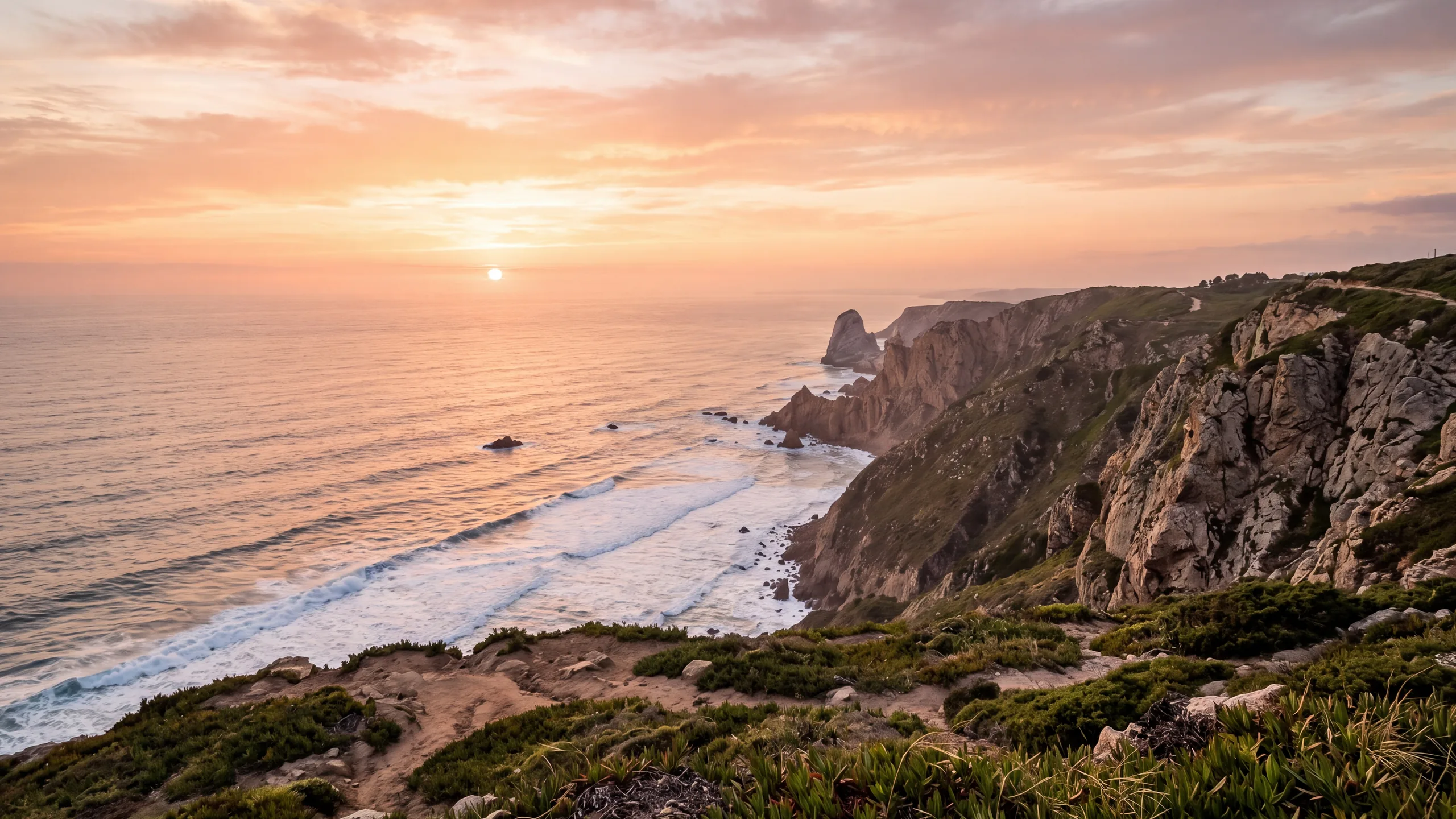
At Cabo da Roca, the sunset seemed to have gathered at the edge of the land. Peach light lay over the Atlantic, and the cliffs below Inês fell into a blue haze threaded with white surf. Behind her, the lighthouse stood clear against the sky. Wind pressed her coat against her legs and carried away the smaller sounds of the visitors around her. She had imagined that reaching the western edge of mainland Europe might feel like an ending. Instead, she felt pleasantly far from anything that needed doing.
The man beside the viewing barrier was having a less peaceful experience. He held a small brass compass in one hand and turned slowly, looking from its needle to the sea. Then he stopped, shook it gently, and repeated the experiment. Inês had watched long enough to become interested when he caught her looking and lifted the compass in apology.
According to the needle, he explained, he was looking east. He had not expected the continent to have moved behind him.
Inês laughed. She was forty-one, old enough to know that a good-looking stranger with a joke did not require an investigation, but she wanted to hear another one. She suggested that he might have bought a compass intended for people who disliked being told where to go. He considered this seriously, then admitted that it had come from his father, who was rather like that.
His name was Rafael. He lived in Coimbra, worked in a hospital kitchen, and had taken a few days to explore the coast after visiting his brother. The compass had traveled through half his childhood on family walks. He had brought it along for pleasure, not navigation, which made its sudden disobedience more puzzling than inconvenient. It had worked perfectly on the table in his room that morning.
He offered it to her. The brass felt warm from his hand, its lid smooth where fingers had polished it over the years. She held it level and waited. The needle shivered, then settled somewhere entirely different from where it had pointed for him. Rafael leaned over to look, close enough that she could see a tiny fleck of gold in his brown eyes.
They tried it twice more, handing the compass back and forth. For her, it was reasonably consistent. For him, it became impossible. He accused it of choosing favorites, and Inês found herself smiling into the wind with a freedom she had not felt all day.
She had come from Porto for a week of wandering, taking trains and buses and letting other people keep track of the road. She drove coaches for a living and loved the work: the early departures, the places changing beyond the glass, the brief fellowship of passengers going somewhere together. On this trip, though, she wanted to stop being the person who knew when everyone had to leave. She had checked her way back to her lodging before setting out, then put the timetable away.
Rafael seemed to understand the distinction. He enjoyed cooking for hundreds of people, he said, but on holiday he liked to eat something he had never needed to plan. They discussed the small pleasures of being away: unfamiliar bread, a street turning unexpectedly toward a view, the relief of discovering that an afternoon could remain undecided. She liked his voice, and the care with which he chose an answer. He did not seem to regard a pause as something he had to rescue her from.
A group moved past them toward the monument. Among them, a sultry woman with sea-green eyes and a wine-red scarf paused nearby to secure her hair beneath her collar before following her companion. The visitors spread out again, leaving Inês and Rafael a quieter stretch of the viewing area. Far below, a wave broke along the foot of a cliff, so distant that its white movement reached them without a separate sound.
Rafael lifted the compass for another look. Its needle swung sharply, and Inês noticed that he had brought his other hand closer to steady the lid. His phone was folded inside a wallet case in that hand. A little metal clasp caught the last light.
She asked him to put the phone in his coat pocket, then hold the compass out at arm's length. This time the needle settled. He brought the case closer again, and it turned toward him as if pulled by a string. The case's magnet had been quietly rearranging the world.
For a moment they simply looked at it. Then Rafael laughed, properly and without trying to protect himself from the joke. Inês loved the way it changed his face. He had been prepared to blame an old compass, the landscape, even himself, while carrying the answer in his other hand. She admitted that she had briefly considered something unusual about the rocks. They were equally pleased not to have said anything more authoritative in front of a larger audience.
He slipped the phone away and set the compass in her palm once more. This time he left his hand beneath hers. She could have closed the lid and returned it; instead, she let their fingers rest together while they looked out over the water. The broad light on the ocean was narrowing, and the wind had become cold enough that his warmth seemed a deliberate gift.
Inês had never minded making the first move in ordinary life. She could ask for directions, settle an argument, tell a roomful of passengers what needed to happen. Wanting somebody was different. It made the smallest gesture feel as though everyone could see it. Yet Rafael was watching her now with an openness that left very little to guess. She closed the compass, placed it in his free hand, and kept hold of the other.
“I'd like to go somewhere with you,” she said.
He asked whether she meant this evening. She told him she did. They agreed on a café in Sintra near where she was staying, somewhere they could sit down out of the wind and continue this without having to part at the parking area. He took out his phone long enough for them to exchange numbers, holding the compass well away from it with exaggerated care. She was still laughing when he stepped closer.
He asked if he could kiss her, and she answered yes before the wind could take the word. His hand came gently to her cheek. She felt the warmth of his mouth and the rough weave of his coat beneath her fingers, and moved nearer, letting him feel how willingly she was there. When the kiss ended, he stayed close. She touched her forehead briefly to his, then kissed him once more because the first had made her want to.
The sun had slipped out of sight, leaving a soft band of amber over the Atlantic. Behind them, people were turning toward the way back. Rafael tucked the brass compass into a separate pocket and offered Inês his hand. She took it, and they walked toward the lighthouse together. For once, she knew where she was going and felt no wish to hurry.