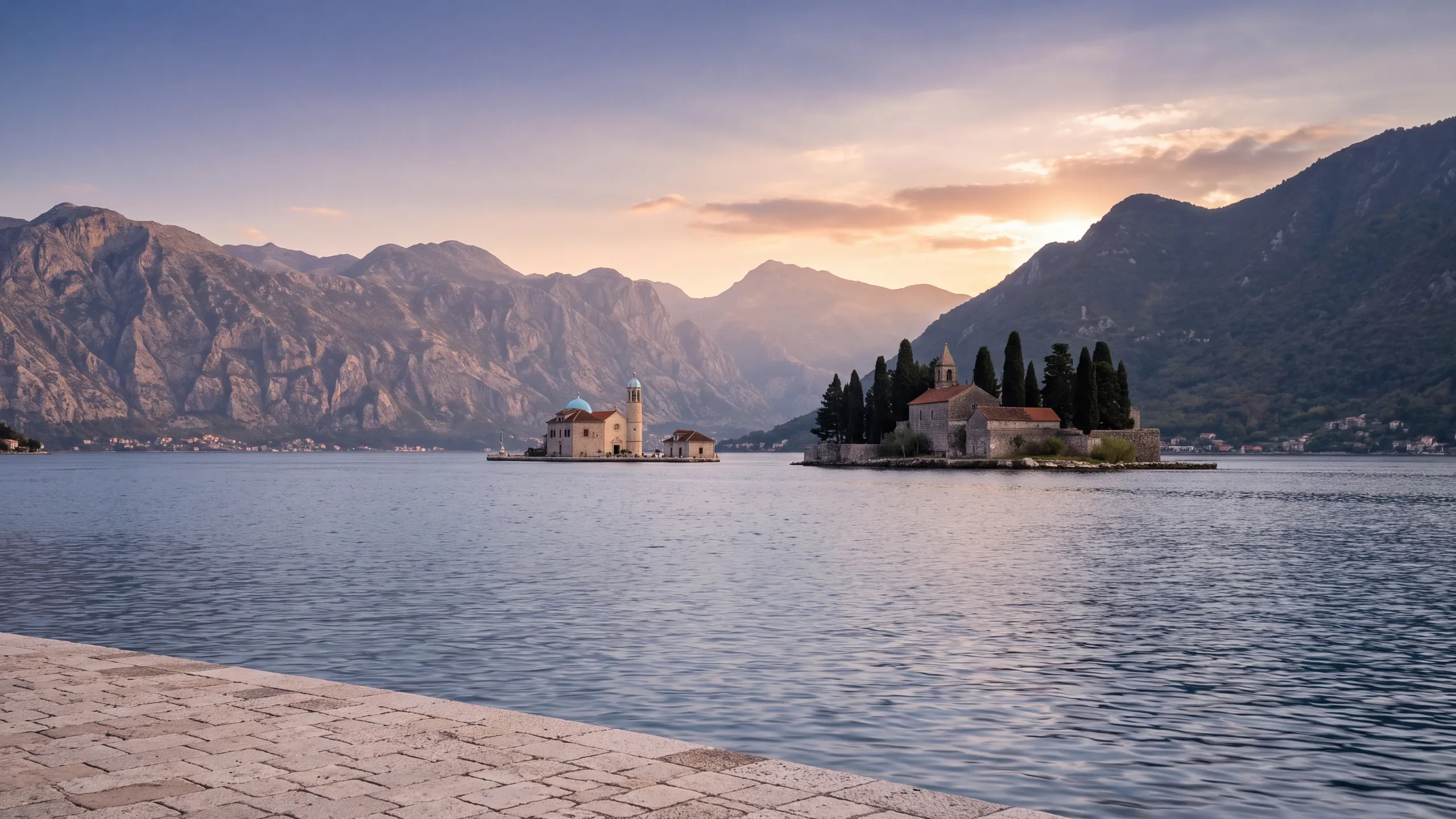
Where Nina Put the Boat
At sunset in Perast, Nina had one drawing left to make. She had promised her nephew a picture for every day she spent on the Bay of Kotor, and Luka, who was seven and had a firm idea of what constituted a picture, had added the condition that somewhere in each one there must be a boat he could find. All week she had hidden them for him. There was a ferry no bigger than a fingernail between two mountains, a dinghy upside down on a wall, even a boat-shaped sugar packet folded by a man who had been sitting next to her on this very stretch of waterfront. She had grown rather fond of that last drawing. Of the man, too, although she had so far found it easier to do something about the drawing.
The paper boat was still in her pocket. Emil had made it on the first evening, while she was explaining Luka’s rules and lamenting the lack of a single vessel in her view. He had borrowed the empty packet from beside her coffee and folded it with the dexterity of a man who had once been a boy in a great many dull classrooms. Since then he had come down to the water every evening after his shift at the small hotel up the street. Nina knew which tooth overlapped its neighbor when he smiled, how he drank the coffee straight away and left the glass of water until it was almost warm, and almost nothing about the life to which he returned once they said goodnight. She had begun to regret the care with which they had kept their talk to paper and boats.
Tonight the church of Our Lady of the Rocks stood pale against the mountains. Across the narrow stretch of water to its right, the cypresses on Saint George had gone nearly black. Nina drew the two islands and left the gap between them open, a strip of peach sky down to the waterline. She had sharpened her pencil twice and was considering a third time when Emil appeared beside her in a clean blue shirt. He had brought quite a handsome little wooden boat, painted green with a cream stripe around its hull. It fitted exactly in his palm. She was about to thank him for solving her problem when she saw the marks on its underside. A line of uneven capital letters spelled out a name, and the E faced the wrong way.
It was his, he admitted. He had made it at eight and kept it in a drawer with his passport and the spare key to his flat. He set it on the wall for her and offered to turn it whichever way she wanted. Nina looked at the model, then at him. She had assumed that on the way home each night he stopped here because it was pleasant to sit by the water. His flat, she now learned, was uphill in the opposite direction. Tonight he had gone all the way home to change his shirt and fetch the boat, and had walked all the way back while she was wearing the point off a perfectly good pencil.
She slid along the wall to make room for him and asked if he would hold it for a minute. In his hand it had a scale and a history that it lost the moment he put it down. She liked the strong bend of his thumb beneath the hull and the way he curled his other hand round his knee to stop himself from fidgeting. As she drew, he told her that the letters spelled his sister’s name. He had made it for her before she was born, and had meant to sail it across the bath with a present on board for her. His mother had suggested he test it with a potato before he tried it with the good silver rattle. He described the sinking with such injured dignity that Nina had to lift the pencil off the page until her hand was steady again.
Behind them a sultry woman with sea-green eyes and a wine-red scarf bent to retrieve a dropped earring from between two paving stones. For an instant both Nina and Emil tilted their heads to follow its progress. When they looked up again their faces were close. She could smell soap on his collar. In the last of the sunlight she saw a pale line on his jaw where he had missed a spot shaving, and felt the particular ache of having learned something about a person on the very evening she would have to leave him.
Emil asked how Luka would ever find a boat so small. Nina turned the book around. She had put the islands at the top of the page and drawn his hand in the foreground, holding the little green hull up to the open water between them. She had drawn enough of his sleeve for anyone looking at the picture to understand that somebody was sitting beside her. It was the first time all week she had let another person into the frame.
He studied it with an expression she could not quite read. Then he said he would like a copy, if it was the sort of thing that could be copied. She could send him one, she said. It would be easy to leave it for him at the hotel. The old formality came out so smoothly that she almost let it stand. Then she saw him reach for the model as if his part in the evening were over, and she shut the book on her pencil.
“Actually, I’d like to send it to you myself. And once I’ve sent it I’d like to be able to call you. I keep finding things all day that I want to tell you about.”
His hand stopped on the green boat. As it happened, he said, he had quite a lot saved up to tell her too. He gave her his number, and while she was putting it into her phone he asked if she knew that she had a streak of graphite across her cheek. She handed him her clean handkerchief and turned her face toward him. He wiped the mark away with the corner of the cloth. The care of that small touch, after six evenings of keeping a sketchbook’s distance between them, made her lean into his hand. He asked softly if he could kiss her. She answered him at once, and the stone against the backs of her knees and the warmth of his mouth and the rough seam of his cuff beneath her fingers all fixed themselves in her memory with a precision no pencil had ever given her.
Much later, in the room where she ought to have been packing, she photographed the drawing for Luka. His reply came while she was still sitting on her suitcase to get it to close. He had circled the green boat in red, and below it her sister had typed a question at his dictation. Who was holding it?
Nina sat on the fastened case and sent the picture on to Emil, with the question still attached. He called before she had time to stand up. He was laughing when she answered. “Tell him that’s Emil. He’s the one who likes his coffee too hot and his company just as it is.” Nina wrote it down exactly. Then she lay back on the bed with the little paper boat on the pillow beside her. For the first time all week neither of them had a walk home to bring their conversation to an end.